Taxaly
Designed a 0→1 AI-assisted tax planning tool that helps people who hate taxes understand and act on their tax decisions before the year is over, not discover the outcome at filing time.

ROLE
Founding Product Designer (Freelance)
TEAM
1 Product Designer, 1 Financial Advisor, 1 Data Scientist, 4 Developers
FOCUS AREA
Engagement Strategy
Behavior Design
Product Experience
TIMELINE
Dec 2024 - May 2025
A SHIFT IN TIMING
From Reporting to Planning
Most tax tools look backward. Taxaly was built to plan forward.
Reporting the Past
Most tax tools help you report what already happened. You gather last year's documents, enter numbers, and find out what you owe or what you're getting back. By then, it's too late to change anything.
Shaping the Outcome
Taxaly needed to do the opposite: help people plan their taxes before the year unfolds, shifting from a once-a-year scramble to proactive decisions that reduce what you owe, not just calculate it.
THE VISIBILITY GAP
What Does Planning Forward Actually Change?
Forward-looking tax planning makes impact visible before the year ends, when adjustments still matter.
APRIL: REACTIVE REALITY
Earning $80,000/yr as a full-time employee.
Taxes are deducted automatically. You only discover the outcome during filing season.
TAX OWED
$1,200
LOCKED
JANUARY: THE INTERVENTION
Rewind to planning and intervention.
Increase 401(k) contribution by $5,000 throughout the year.
TAXABLE INCOME
DROP
TAX LIABILITY
REDUCED
TAX OWED
$300
$900 SAVED
The decision wasn't complicated. It was just invisible.
THE REAL CHALLENGE
Designing for Confidence,
Not Calculation
When we started shaping Taxaly, the challenge wasn’t building tax calculations. It was designing for people who don’t fully understand what applies to them, yet still have to make high-impact financial decision especially salaried professionals navigating investments, equity, and side income.
WHAT WE OBSERVED
This wasn’t just a usability issue.
It was a trust issue
Through early competitive analysis, journey mapping, and conversations with a financial advisor, a few patterns became clear:
Outcomes come too late
Users only see their total owed or refund amount at filing time, long after opportunities to adjust contributions, withholdings, or deductions have passed.
Knowledge is assumed
Most tools expect users to understand terms like “safe harbor,” “estimated payments,” or contribution limits, without clarifying how they apply personally.
Simplicity hides trade-offs
“Streamlined” flows prioritize speed over visibility, collapsing complex decisions into single recommendations without showing alternatives.
Unclear consequences create hesitation
When users can’t see how one decision affects the rest of their tax picture, they hesitate, or default to doing nothing.
WHERE THIS LED US
Tax planning operates under uncertainty.
Income shifts throughout the year. Contribution limits vary. Eligibility rules depend on individual circumstances.
INCOME
Isn't fixed
DEDUCTIONS
Aren't universal
LIMITS
Aren't intuitive
ELIGIBILITY
Changes by profile
In that context, optimizing for speed or minimal interaction would have been misleading
01
The system needed to make cause and effect visible.
02
Users needed to see how a decision changed their outcome before committing to it.
Taxaly wasn’t about simplifying taxes.
It was about designing for confidence under uncertainty.
THE TURNING POINT
Why I Pushed Back
on a Fully Conversational Product
The team was excited about building something fully conversational. It aligned with the broader shift toward AI-first interfaces. It was clean, bold, and easy to articulate: “Just talk to your taxes.”
It was compelling. It was modern. But when I mapped real planning scenarios, adjusting withholdings, modeling 401(k) contributions, the gaps became obvious.
In a domain defined by uncertainty, removing structure didn’t reduce anxiety. It removed control.
In a purely conversational flow:
Users couldn’t see their full tax picture at a glance.
Comparing “before vs after” required scrolling through history.
Recommendations appeared authoritative, but reasoning wasn't visible.
There was no stable surface for users to review and validate decisions.
"I wasn’t convinced that conversation alone could support real financial decisions."
Proposing a hybrid model meant pushing against momentum.
I knew a hybrid approach would feel less novel. It risked feeling less ambitious. But as we walked through real user scenarios, the trade-off became harder to ignore.
STRATEGIC PIVOT
"The goal wasn’t to prove we could build an AI interface. It was to design something people could trust with real money decisions."
THE SYSTEM WE BUILT
A Hybrid Planning Experience
The hybrid decision gave the product a direction. But the real work was designing how conversation and structure worked together, while addressing timing, visibility, trust, and assumed knowledge across the entire system.
Four Experience Pillars
That Shaped the Product
01
Plan Before It’s Too Late
02
Make Impact Visible
03
Guide Without Taking Control
04
Teach in Context
ONBOARDING
Before You Can Plan Forward,
You Need a Clear Baseline
Before modeling decisions or suggesting adjustments, we needed a reliable starting point. This setup builds the financial foundation for the year ahead.
Make Critical Decisions Visible
Filing status isn’t a minor detail, it changes tax brackets, eligibility, and planning strategy. We surfaced it early to prevent hidden assumptions from shaping the outcome. Because this was an MVP, we intentionally supported the most common filing statuses first. Instead of hiding unavailable options, we surfaced them transparently and allowed users to opt in for updates.
Build the Year in Context
Collect What Matters, Nothing More

THE BASELINE
Your Year, Made Visible
Based on the information provided, the system generates a live snapshot of the current year, not a final outcome, but a starting point.
Total tax is calculated
in real time
Income flows into taxable
income transparently
Open actions highlight decisions that can still change the outcome
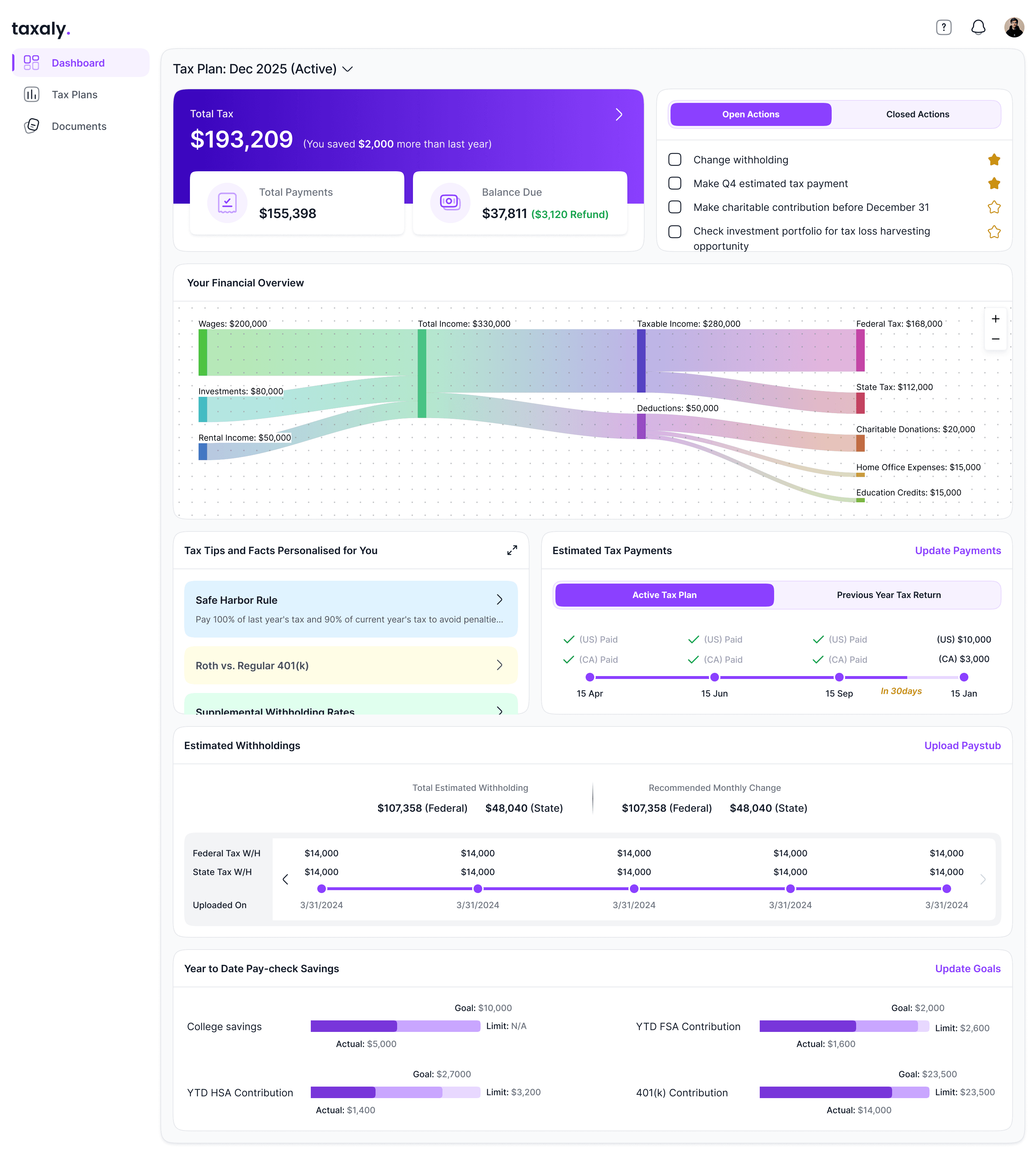
Balancing transparency with cognitive load was a key tension. We chose to surface complexity, but layered it progressively through drill-downs and contextual explanations.
The dashboard wasn’t static. Every number could be explored, adjusted, or understood in context.
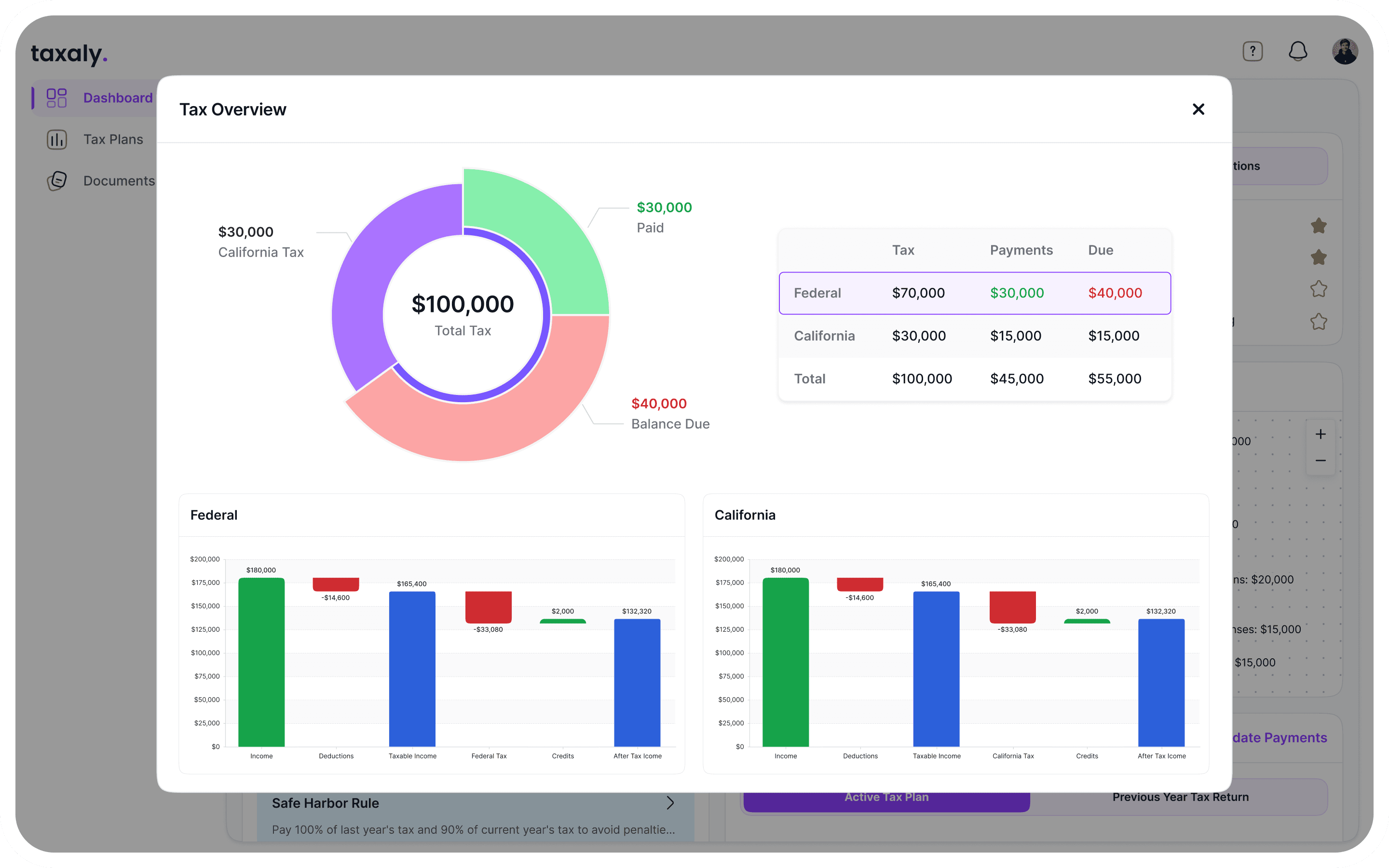
See Where the Number Comes From
Users can drill into federal and state components to understand how income, deductions, and credits shape the total. Nothing is presented as a black box.
Adjust Before It’s Too Late
Explain Without Assuming Knowledge
THE SHIFT FROM VIEWING TO SHAPING
What Happens If You Change Something?
Once users had a clear baseline, the product stopped being a dashboard.
It became a decision environment. Tax planning isn’t a single adjustment. It’s a layered system.
Income
ADJUSTMENTS + DEDCUTIONS
Lower Your Taxable Income
Tax Calculated
Before Credits
CREDITS
Credits Reduce the Tax
Final Tax Owed
WITHHOLDINS + ESTIMATED PAYMENTS
What You Already Paid
Refund
If you paid more than you owe
Balance Due
If you paid less than you owe
Taxaly didn’t simplify this complexity away. It made it explorable.

Meet Aggy
Aggy is a 27-year-old product designer earning $102,000 a year. His paycheck feels steady. Predictable. Last year, he still owed $1,800 in April, and didn’t see it coming. This year, he logs in early, while there’s still time to change the outcome.
BASELINE SNAPSHOT
February 12, 2026 — projecting the full 2026 tax year
PROJECTED 2026 TOTAL TAX
$19,600
PROJECTED 2026 WITHHOLDING
$17,900
IF NOTHING CHANGES
$1,700
Due in April 2027
Let's See How Aggy Changes This
That $1,700 doesn't disappear on its own.
Aggy won't make one big move. He'll move through the plan the way most people actually do, checking, adjusting, and watching the number respond. One step at a time

01 — INCOME
Is This Income Accurate?
Before changing anything, Aggy checks what the system is using to calculate his taxes.
W-2 income
$102,000
RSUs
None
Investment income
None
Side hustle
None
The inputs are accurate.
PROJECTED BALANCE REMAINS
$1,700 due
No change from baseline yet. But this step matters.
Before shaping the plan, Aggy confirms the inputs are correct.
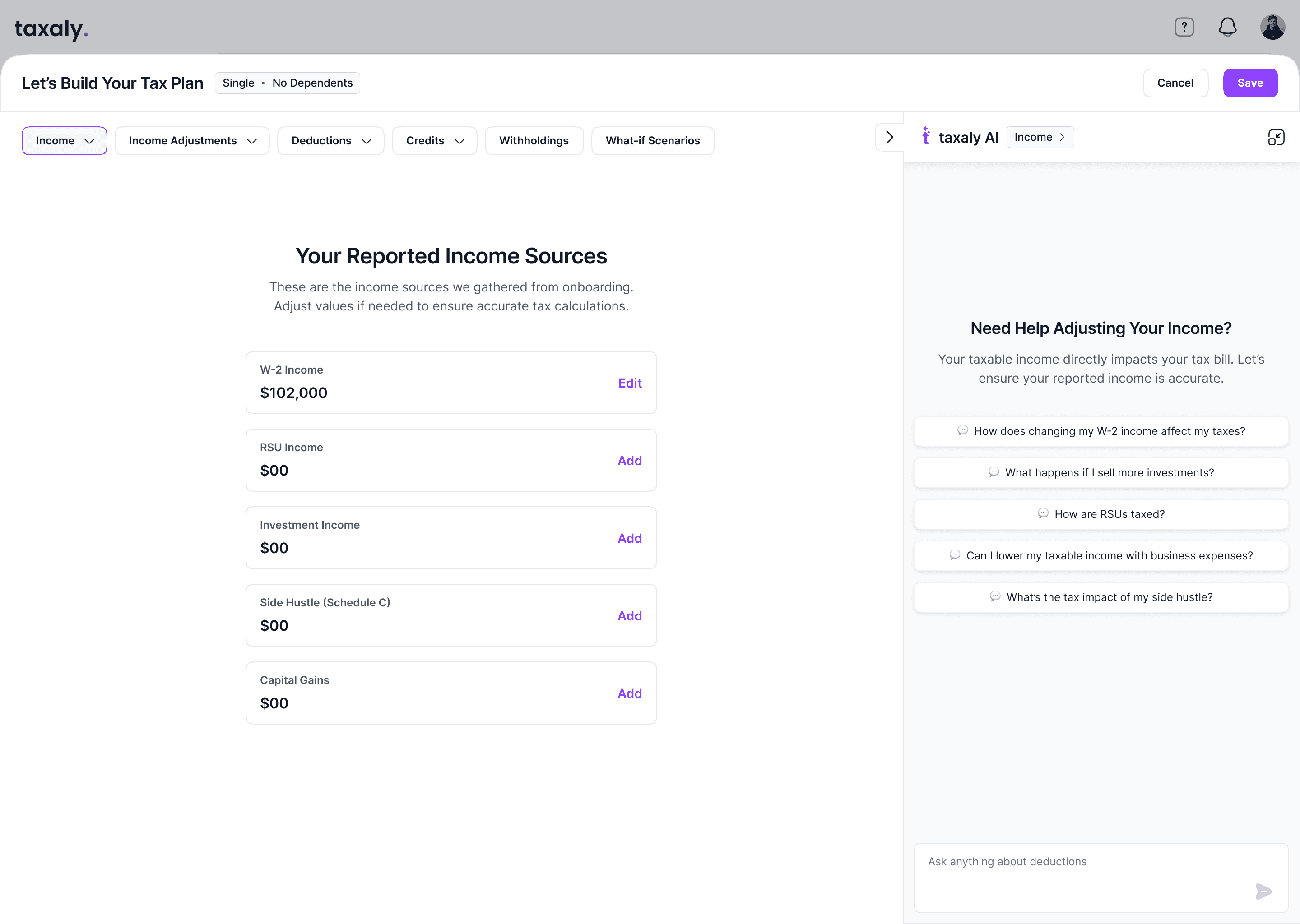
01 — INCOME
Is This Income Accurate?
Before changing anything, Aggy checks what the system is using to calculate his taxes.
W-2 income
$102,000
RSUs
None
Investment income
None
Side hustle
None
The inputs are accurate.
PROJECTED BALANCE REMAINS
$1,700 due
No change from baseline yet. But this step matters.
Before shaping the plan, Aggy confirms the inputs are correct.